
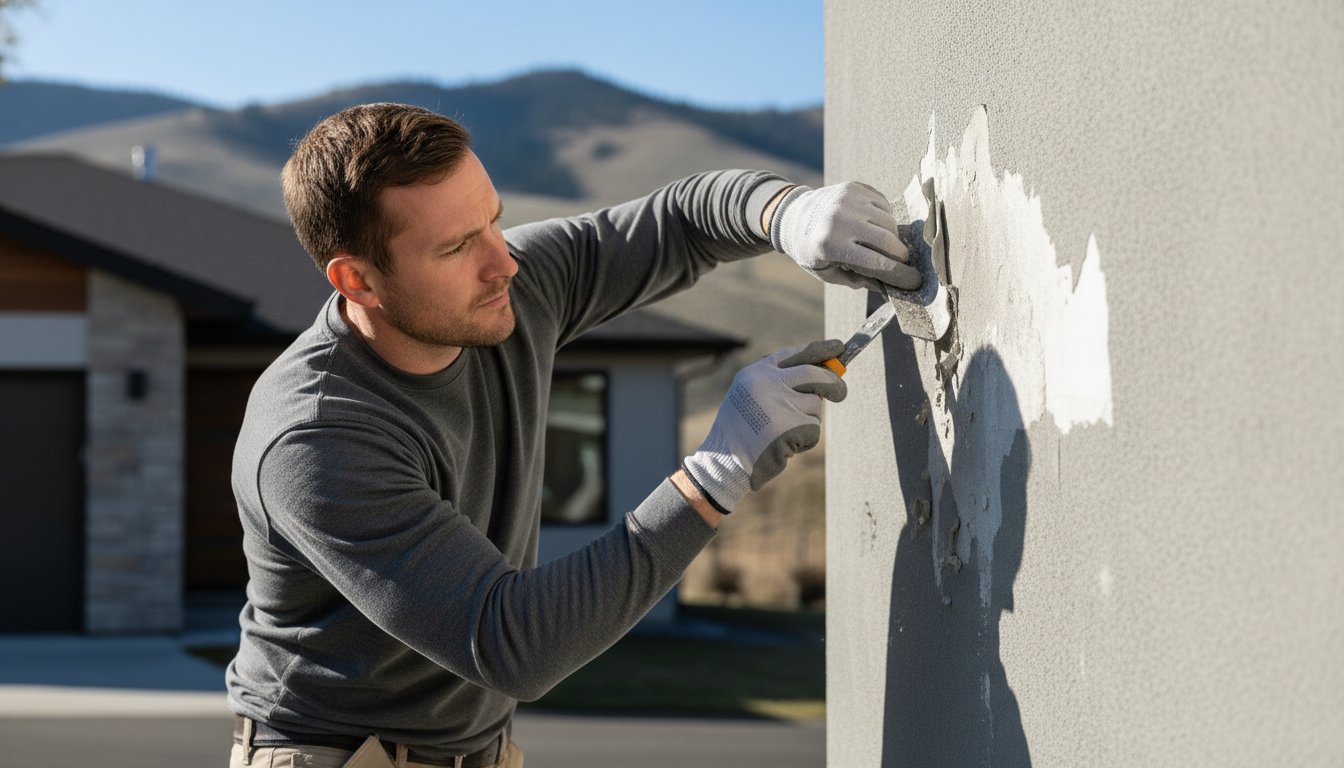
Last April, a homeowner in Juniper Ridge discovered a pile of sandy debris on their patio after a week of 15 degree temperature swings. This sight is all too common in the Thompson Okanagan, where our intense climate tests the limits of exterior finishes. You likely recognize that ignoring these cracks invites moisture to seep behind the substrate, which leads to costly structural damage over time. Learning exactly how to fix peeling stucco before painting is the only way to safeguard your investment and achieve a flawless, professional finish that lasts.
We agree that matching a unique stucco texture feels like a daunting task, especially when you want a seamless look. However, mastering this repair process allows you to elevate your home's curb appeal while providing a durable shield against the elements. In this guide, we share the meticulous techniques used by local experts to repair damage and select the specific masonry primers that bond permanently to Canadian stone and grit. You will gain the confidence to transform your exterior into a uniform, resilient surface that stands up to the Kamloops sun with precision and care.
Key Takeaways
- Understand how Kamloops’ extreme temperature swings and freeze-thaw cycles impact stucco adhesion and why a sound substrate is essential for a lasting finish.
- Master the professional steps for how to fix peeling stucco before painting, focusing on meticulous scraping and preparation to ensure a flawless surface.
- Learn to select premium patching compounds and bonding agents that create a seamless, durable texture while ensuring the new repair adheres perfectly to the original wall.
- Discover why specialized masonry primers and elastomeric coatings are non-negotiable for elevating your home’s protection against the local climate and future cracking.
- Identify the critical red flags that signal when to call in trusted experts to safeguard your home’s structural integrity and ensure a professional, high-end result.
Understanding Why Stucco Peels in the Kamloops Climate
Stucco peeling represents a critical failure of adhesion between the exterior coating and the substrate. For Kamloops homeowners, this isn't just a cosmetic issue; it's a signal that the protective envelope of the home is compromised. Understanding how to fix peeling stucco before painting begins with diagnosing the root cause. Often, the culprit is the intense environmental stress unique to the Thompson-Okanagan region. Before you can restore your home's exterior, it helps to understand the base material. What is Stucco? Traditionally, it's a durable mixture of cement, sand, and lime, but it requires specific conditions to remain stable over decades.
Our local climate puts immense pressure on these materials. Kamloops frequently experiences summer highs exceeding 38°C and winter lows that plummet below -25°C. This 60-degree temperature variance causes the substrate to expand and contract aggressively. Efflorescence, the white, powdery salt deposits you might see on your walls, is a primary driver of paint failure. When moisture travels through the stucco, it carries minerals to the surface. As the water evaporates, these salts crystallize under the paint film, eventually popping the coating off the wall. We often see premature peeling on homes where previous DIY attempts used non-breathable paints that trapped this moisture instead of allowing it to escape.
The Role of Moisture and Thermal Expansion
Water is the most destructive force for any Kamloops exterior. During our winter freeze-thaw cycles, any moisture trapped behind the stucco surface expands as it turns to ice. This internal pressure creates microscopic fractures that eventually lead to visible peeling. Stucco is naturally porous and needs to breathe to prevent internal rot and mold. If a previous contractor applied a heavy, non-permeable sealant, they likely sealed in the home's "perspiration." You can tell damage is cosmetic if it only affects the paint layer, but structural damage usually presents as deep cracks or bulging sections that feel soft to the touch.
Identifying Different Types of Stucco Failure
Determining how to fix peeling stucco before painting requires a precise assessment of the damage type. Not every crack requires the same level of care. Use this checklist to evaluate your home's condition:
- Hairline Cracks: Usually less than 0.15 cm wide, these are common results of minor house settling and are easily filled.
- Localized Flaking: Often caused by "flashing" issues where water drips from windows or gutters directly onto the wall.
- Large-scale Delamination: This occurs when the stucco pulls away from the underlying lath entirely.
You can perform a "hollow sound" test by gently tapping your walls with a rubber mallet. A solid, dull thud means the stucco is still bonded. A hollow, drum-like ring indicates the stucco has detached from the lath. If more than 15% of a wall section sounds hollow, the underlying metal lath may be rusted or damaged, requiring a more technical restoration to elevate the home back to its original standards.
Step 1: Preparation, Scraping, and Cleaning
Achieving a flawless exterior finish starts with a meticulous foundation. When you're learning how to fix peeling stucco before painting, it's easy to underestimate the preparation phase. You'll need a specific toolkit to begin: professional-grade wire brushes, flexible putty knives, and a stiff-bristled broom for clearing debris. Our team always emphasizes that the quality of your paint job is only as good as the surface beneath it. Removing every flake of loose material is the only way to ensure your new coating bonds correctly and lasts for years in the varied Kamloops climate.
The Precision Scraping Technique
Precision is vital during the removal process. You shouldn't stop scraping just because the visible peeling ends. We recommend extending your work area at least 5 to 8 centimetres beyond the damaged zone to find a truly sound edge. A sound edge is a point where the stucco no longer flakes away when firm pressure is applied with a putty knife. Use a technique called feathering to sand down the edges of the remaining stucco; this creates a gradual transition that prevents the patch from looking like a raised island after painting. Be careful not to apply excessive force. Hitting the wall too hard can damage the underlying wire lath, leading to structural issues that require more expensive repairs. For owners of older properties, referencing Historic Stucco Repair Techniques can provide deep insights into maintaining material integrity during this sensitive stage.
Pressure Washing vs. Manual Cleaning
Cleaning the surface is the next critical step to remove dust, salt, and biological growth. While pressure washing Kamloops homes is a common practice, you must handle the equipment with care. High pressure can force water deep into existing cracks, which leads to internal rot or mold behind the substrate. For stubborn grime, a mild solution of trisodium phosphate (TSP) is highly effective. Apply it with a stiff brush to lift contaminants without saturating the wall. After cleaning, wait at least 48 to 72 hours for the stucco to dry completely. Trapped moisture is the leading cause of premature paint failure; it's better to wait an extra day than to rush into patching. If the scope of the damage feels overwhelming, our experts can elevate your home's exterior with professional-grade restoration and precision care in every stroke.
Step 2: Patching and Texturing for a Seamless Finish
Precision is the foundation of a lasting repair. When you are learning how to fix peeling stucco before painting, the choice of material determines whether your new coat of paint will last three years or twenty. Our team specializes in selecting the right compound for the specific demands of the Kamloops climate. While pre-mixed acrylic patches offer convenience for tiny hairline cracks, we recommend traditional cement-based stucco for structural repairs. Cement-based products provide the breathability and strength required to withstand our local temperature swings.
Before applying any new material, we apply a high-grade liquid bonding agent to the prepared substrate. This creates a chemical bridge that ensures the new patch adheres permanently to the old surface. Without this step, the patch often delaminates within a single season. For deeper holes or gouges, we build the patch in layers approximately 1 centimetre thick. This staged approach prevents the material from shrinking or sagging, which are the primary causes of internal cracking.
We utilize a wet-on-wet technique to achieve a professional result. This involves dampening the edges of the existing stucco before applying the new mixture. By working with these damp edges, we can feather the new material into the old, eliminating harsh lines that would otherwise show through the finished paint job.
Matching Your Existing Stucco Texture
A flawless repair requires a deep understanding of local architectural styles. Kamloops homes often feature "Dash," "Lace," or "Sand" finishes. To replicate a Dash finish, we use a whisk broom or a specialized hopper gun to spray small aggregates onto the wet surface. For a Lace finish, we let the peaks of the dash dry slightly before gently flattening them with a trowel. If your home has a Sand finish, a sponge float moved in steady, circular motions creates that uniform, grainy look. Texture blending is the secret to an invisible repair, ensuring that the patched area disappears into the surrounding wall once the paint is applied.
Curing and Drying Times in BC Weather
The climate in the Thompson Valley presents unique challenges for masonry work. During our hot summer months, temperatures frequently exceed 30°C, which can cause cementitious patches to dry too quickly and become brittle. We implement a process called mist curing to combat this. By lightly spraying the patch with a fine water mist twice a day for 48 hours, we slow down the evaporation process and allow the cement to reach its full structural strength.
You must respect the chemistry of the material before moving to the next stage. Even if the surface looks dry, the internal pH levels need time to stabilize. We advise a minimum wait time of 72 hours for small patches and up to 7 days for larger structural repairs before applying any primer. This patience ensures your premium paint finish won't bubble or peel due to trapped moisture or alkaline burn.

Step 3: Priming and Painting for Long-Term Durability
Once your repairs have fully cured, the final phase ensures your home remains protected for decades. Understanding how to fix peeling stucco before painting involves more than just a topcoat; it requires creating a chemical bond that stands up to the unique Thompson-Okanagan climate. We prioritize a dedicated masonry primer because it's non-negotiable for porous surfaces. Stucco is naturally alkaline, and standard acrylic primers often fail when they react with high pH levels, leading to the very peeling you're trying to prevent. A premium masonry primer neutralizes this alkalinity, sealing the surface and providing a "tooth" for the paint to grip.
For the finish, we recommend elastomeric paint for most Kamloops residences. This isn't just standard paint; it's a thick, flexible coating designed to stretch up to 300% of its original length. This elasticity allows the coating to bridge small future cracks that inevitably form as your home settles. Two coats are essential to provide maximum protection against the intense UV rays we experience in the interior, ensuring your vibrant colour doesn't fade prematurely under the summer sun.
To see how these high-performance coatings look when applied to luxury residential properties, check out Crandall Painting & Stucco for examples of premium exterior transformations.
Choosing the Right Primer and Paint
High-pH resistant primers outperform standard acrylic options by preventing "efflorescence," that white powdery substance that can push paint right off the wall. In Kamloops, where temperatures swing from -30°C in winter to +40°C in summer, elastomeric coatings act like a protective skin. They move with the thermal expansion of your home rather than cracking under the pressure. To ensure your home looks as good as it performs, you can find inspiration in these 2026 paint colour ideas to elevate your exterior with local style.
Precision Application Tips
Achieving a flawless finish on heavy-textured stucco requires specific tools. We use rollers with a 1-inch to 1.5-inch nap to ensure the product reaches into every deep crevice and valley of the masonry. Our team specializes in the back-rolling technique, where we follow a sprayer with a manual roller to work the paint into the substrate. This meticulous process eliminates lap marks and ensures a uniform thickness across large walls. To avoid flash-drying, which prevents the paint from bonding correctly, we schedule painting for the cooler parts of the day. Avoid working in direct sunlight when temperatures exceed 28°C, as this can ruin the finish before it has a chance to level.
Ready to revitalize your home with a finish that lasts? Contact BC Interior Painting Pros for a free estimate and experience precision and care in every stroke.
When to Call Professional Stucco Repair Experts
Sometimes, learning how to fix peeling stucco before painting reveals deeper issues that a simple patch kit cannot solve. Homeowners in Kamloops should stay alert for "red flag" symptoms that signal structural or moisture problems. Large horizontal cracks, for instance, often indicate foundation settling or significant shifting that requires more than a cosmetic fix. If you notice water stains on your interior drywall or a musty smell near exterior walls, moisture has likely breached the building envelope. These scenarios require a professional assessment to prevent structural remediation costs that can easily exceed C$10,000 if left unaddressed.
Safety is another critical factor. Most Kamloops homes feature multi-storey designs that require scaffolding or high-reach ladders to access the upper eaves. Falling from just 10 feet accounts for roughly 15% of construction-related injuries in Canada, making DIY repairs on upper levels unnecessarily dangerous for an untrained homeowner. Professional teams arrive with the right safety gear and fall protection. We ensure the job is completed without incident while you stay safely on the ground.
The Benefit of Professional Equipment and Experience
Our team uses specialized pneumatic hoppers and texture brushes to achieve a perfect match with your existing finish. This precision prevents the "patchy" look that often plagues DIY attempts. We apply professional-grade elastomeric coatings that offer 300% more elasticity than standard big-box store paints. This flexibility allows the stucco to breathe and move during Kamloops' extreme temperature swings, which range from -30°C in winter to +40°C in summer. As a fully insured and locally operated business, we provide a comprehensive warranty that gives you long-term peace of mind. Our expertise in exterior painting Kamloops ensures your home remains protected against the elements for years to come.
Elevate Your Home with a Professional Finish
Hiring professional painters Kamloops saves you approximately 40 to 60 hours of intensive labor on a standard residential project. Beyond the time saved, a flawless exterior significantly boosts your home's resale value. Real estate data suggests that high-quality curb appeal can increase a property's market value by up to 7%. We treat every project with precision and care in every stroke, ensuring a transformation that revitalizes your living space. Don't settle for a temporary fix when you can elevate your property with a lasting solution. Contact BC Interior Painting Pros today for a free meticulous estimate and let us restore your home's beauty with confidence.
Protect Your Investment With a Flawless Exterior
Your home’s exterior faces unique challenges from the Kamloops climate, where seasonal shifts often compromise even the toughest surfaces. Mastering how to fix peeling stucco before painting is about more than a quick patch; it requires meticulous scraping, deep cleaning, and the application of premium materials designed for long-term durability. By focusing on these critical preparation steps, you ensure your final coat of paint adheres perfectly and provides a reliable barrier against moisture for years to come.
With over 20 years of local industry experience, BC Interior Painting Pros delivers results that stand the test of time. Our fully insured team upholds meticulous quality standards, bringing precision and care to every stroke to ensure your property looks its absolute best. We take pride in being the trusted experts that Kamloops homeowners rely on for high-end transformations and complete peace of mind. We don't just apply paint; we revitalize your entire environment.
Elevate your home with our professional stucco repair and painting services in Kamloops today!
A beautiful, revitalized home is just one professional service away.
Frequently Asked Questions
Can I just paint over peeling stucco if it is only a small area?
You shouldn't paint directly over peeling stucco because the new coat won't bond to a failing surface. Even a small patch of loose material indicates that the underlying adhesion has compromised. If you ignore these spots, the new paint will likely flake off within 12 months. Our team meticulously scrapes away every loose edge to ensure a stable foundation for a long lasting finish.
How long does stucco repair take to dry before I can start painting?
Small stucco patches typically require 48 hours to dry, while larger structural repairs need 10 to 28 days to cure fully. This timeline ensures the pH levels stabilize so the paint doesn't burn or peel. In the dry Kamloops climate where summer humidity often drops below 30 percent, smaller repairs might feel dry quickly, but waiting the full 48 hours prevents moisture from being trapped under the new coating.
What is the best type of paint to use on a stucco exterior in Kamloops?
Premium 100% acrylic latex or elastomeric masonry paint is the best choice for the local environment. These products offer the flexibility needed to withstand Kamloops temperature swings that range from 35°C in July to -20°C in January. We use high end coatings that allow the masonry to breathe while providing a durable barrier against the elements. This approach protects your investment and elevates your home's exterior aesthetic.
Do I need to prime the entire wall or just the patched areas?
You must spot-prime every new patch, though we recommend a full coat of masonry primer if the existing paint is over 12 years old. Priming is a critical step when you learn how to fix peeling stucco before painting to ensure uniform suction across the surface. Without a dedicated primer, the patched areas will absorb paint differently than the rest of the wall, resulting in visible blotches called flashing.
Why does my stucco keep peeling even after I fixed it last year?
Recurring peeling usually happens because of trapped moisture or inadequate surface preparation. If you didn't remove the chalky oxidation from the old paint or if there's a leak in your gutter system, the new bond will fail. We see this often when homeowners skip the cleaning phase. A professional pressure wash and a high quality sealer are essential to prevent the 10 percent of failed areas from spreading across the entire wall.
Is it better to use a brush, roller, or sprayer for painting stucco?
We use an airless sprayer combined with a back-rolling technique for the most professional results. The sprayer reaches into the deep pits of the stucco texture while a heavy 20mm or 30mm nap roller pushes the paint into the pores. This dual method ensures 100 percent coverage and a thicker dry film. Relying on a brush alone for a 2,500 square foot home is inefficient and rarely provides the uniform protection your exterior requires.
How much does professional stucco repair and painting cost in BC?
Professional exterior painting for a standard home in British Columbia typically ranges from C$4,000 to C$9,000 based on 2023 market data. Specific stucco repairs can add C$600 to C$3,000 to the project total depending on the amount of delamination and cracking. We provide transparent, detailed estimates that reflect the meticulous care and premium materials required to revitalize your property. Every quote focuses on providing a flawless, worry free experience.


