
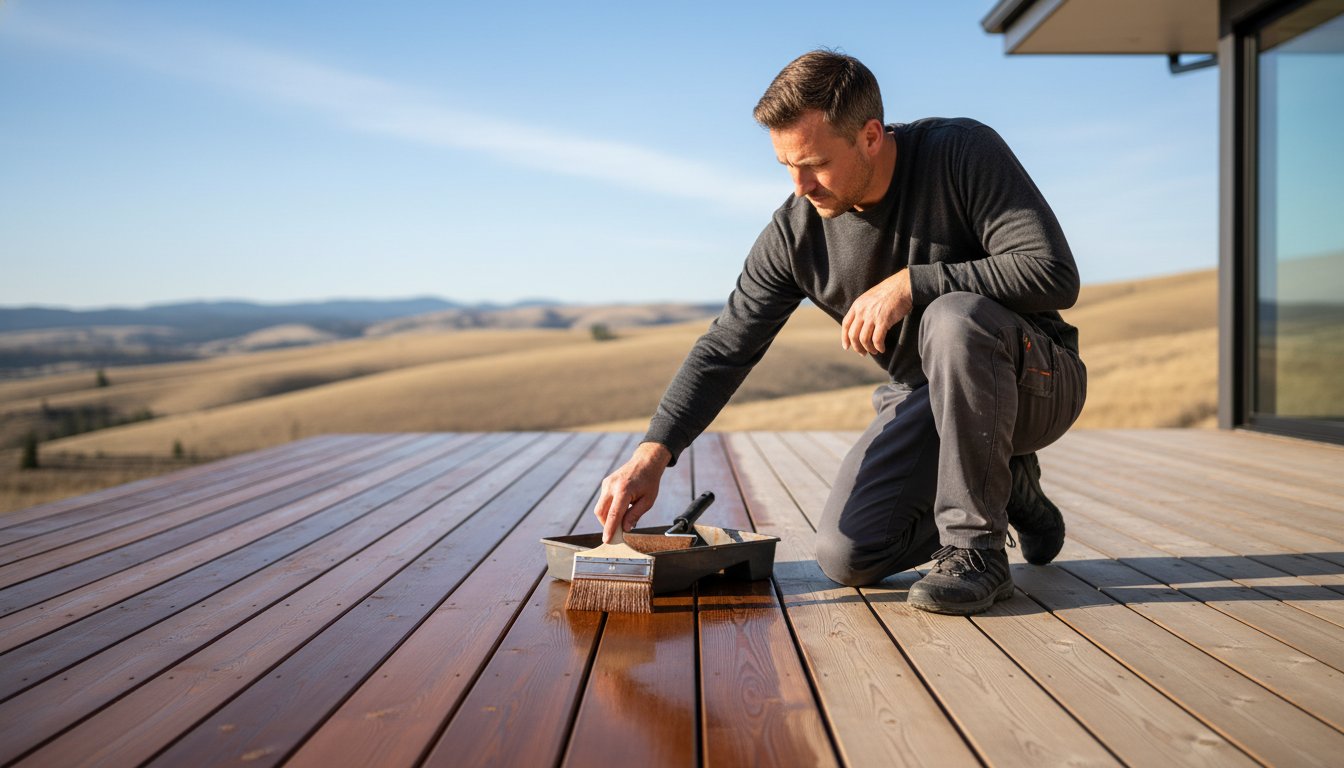
What if the reason your deck peels every spring isn't the product you bought, but the way you're fighting the British Columbia climate? Determining whether is it better to stain or paint a deck in BC is more than a simple matter of aesthetics; it's a strategic decision to protect your home from heavy snow and relentless coastal rain. We understand the frustration of watching a beautiful outdoor space turn into a high-maintenance chore of grey, weathered wood and flaking layers. You deserve a revitalized environment where you can actually relax, rather than a surface that demands constant, expensive repair.
This 2026 guide provides the definitive answer to the paint vs. stain debate, specifically tailored for our unique West Coast challenges. You'll discover how to achieve maximum protection against UV rays and moisture while significantly lowering your long-term maintenance effort. We will examine the latest water-based formulations and the critical role of professional preparation, ensuring your deck remains a beautiful, durable sanctuary for years to come. Our team prioritizes the intersection of accuracy and attentiveness to help you make the right choice for your home's exterior.
Key Takeaways
- Understand how the unique BC freeze-thaw cycle and intense Interior sun impact the lifespan of different wood finishes.
- Learn the technical differences between film-forming barriers and penetrating pigments to decide if it is better to stain or paint a deck in BC based on your specific wood condition.
- Identify whether your outdoor space is "stain-grade" or "paint-grade" to ensure you select the most durable treatment for long-term protection.
- Compare the maintenance cycles of each option to align your choice with your preferred balance of aesthetics and upkeep effort.
- Discover why professional moisture testing and meticulous surface preparation are the essential steps to prevent premature peeling and failure.
The BC Climate Factor: Why Your Deck Choice Matters in 2026
The British Columbia landscape offers breathtaking views, but it also presents a punishing environment for outdoor timber. Deciding is it better to stain or paint a deck in BC requires a deep understanding of our local weather patterns. In the Interior, the intense summer sun acts like a slow-burning furnace. UV radiation penetrates deep into the wood cells, breaking down lignin, the natural glue that holds wood fibers together. When lignin fails, the wood surface turns grey and brittle, making it nearly impossible for traditional coatings to bond effectively.
We also face the relentless "Freeze-Thaw" cycle. During a typical BC winter, moisture seeps into the smallest cracks. When temperatures drop, this water expands as ice, exerting massive pressure. If you've applied a film-forming paint, this trapped moisture has nowhere to go. It pushes against the coating from the inside out, leading to the rapid peeling and flaking that plagues so many local homeowners. This is why a professional approach focuses on how a product interacts with the wood's biology, not just how it looks on day one.
Cedar remains a popular choice for its natural tannins, but these same oils can cause "tannin bleed" through light-coloured paints if not sealed with precision. Pressure-treated lumber, while durable, often resists initial staining until it has properly seasoned. By 2026, environmental standards have shifted heavily toward water-based, low-VOC formulations. These modern products, such as the latest wood stain composition, are engineered to breathe. This allows moisture to escape rather than trapping it against the wood grain, which is vital for long-term structural integrity.
Kamloops Sun vs. Coastal Humidity
The dry heat of Kamloops is a world away from the damp humidity of the coast. In the Interior, high UV levels make solid stains a superior choice for many homeowners. These products provide a denser pigment shield that reflects solar energy. Without this protection, the dry air causes wood to shrink and warp rapidly, which can snap the bond of brittle, low-quality paints. We focus on choosing a finish that maintains flexibility, ensuring your deck won't crack under the 35°C heat of a July afternoon.
Snow Load and Winter Protection
Standing snow is the silent killer of horizontal deck surfaces. Unlike vertical siding, a deck floor must support heavy, wet snow for months. This constant contact forces moisture into the wood grain. If you use ice-melt chemicals to clear your path, be cautious. These salts can chemically react with certain paint resins, causing them to soften and lift. Preparing for the "big freeze" every autumn involves more than just a quick sweep. It requires a resilient coating that can withstand the weight of the snow load and the abrasive nature of winter maintenance.
Painting vs. Staining: A Technical Breakdown of Protection
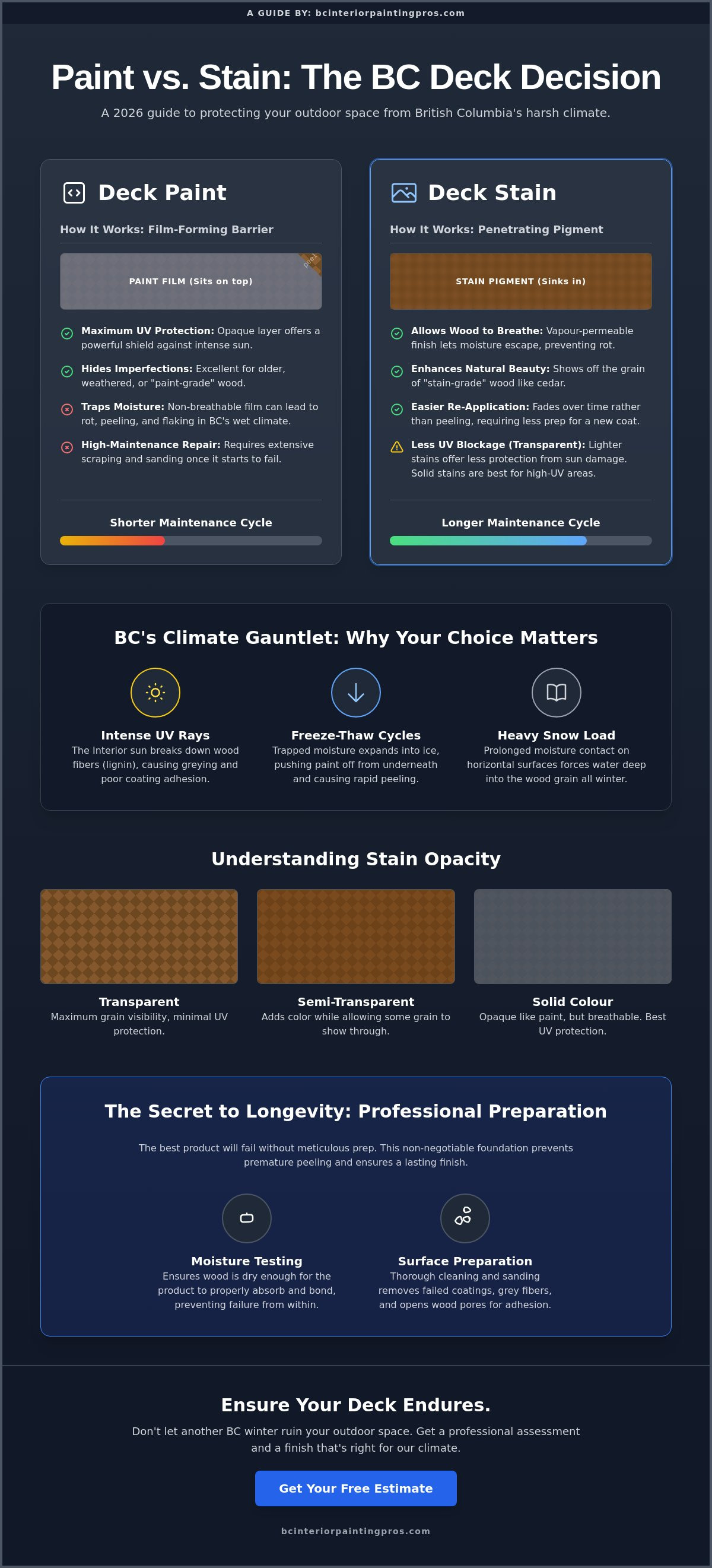
When homeowners ask is it better to stain or paint a deck in BC, the answer lies in the physics of the coating. Paint acts as a film-forming barrier. It creates a thick, opaque layer that sits directly on top of the wood surface. This blanket effect provides an incredible shield against the elements, but it also creates a closed system. Stain, conversely, is a penetrating pigment. It doesn't just sit on the surface; it bonds with the wood fibres, soaking into the pores to protect the timber from the inside out.
Understanding opacity is the next step in your decision. Modern stains come in three primary levels: transparent, semi-transparent, and solid-colour. Transparent stains offer a clear view of the wood's natural character, while semi-transparent options add a hint of colour without masking the grain. Solid-colour stains are often mistaken for paint because they are completely opaque. However, they still function as a stain by allowing the wood to breathe. Choosing the right opacity often depends on whether you're working with high-end cedar or older preservative-treated wood that may require more coverage to look its best.
Breathability is the most critical factor for longevity. Because paint creates a non-porous shell, it can trap moisture that naturally rises through the wood from the ground or through small cracks in the finish. This trapped water is the primary cause of deck rot in our climate. Stains are engineered to be vapour-permeable. They allow moisture to escape, which prevents the wood from festering underneath the coating. If you're looking for a finish that prioritizes the structural health of your timber, our deck and fence staining specialists can help you select a product that balances beauty with essential ventilation.
The Pros and Cons of Deck Paint
Paint offers maximum UV protection because its thick pigments block nearly all solar radiation. It also provides infinite colour customization, allowing you to match your deck perfectly to your home's trim or siding. It's the best choice for hiding deep cracks or heavy weathering in older wood. The downside is the failure mode. When paint fails, it peels and flakes, requiring intensive scraping and sanding before you can apply a fresh coat. It turns a simple refresh into a major restoration project.
The Pros and Cons of Deck Staining
Staining highlights natural grain patterns, providing a high-end artisan look that paint simply cannot replicate. Maintenance is much more straightforward; stain doesn't peel, it simply fades over time. When it's time for a refresh, you usually only need a thorough cleaning rather than a full strip. The trade-off is frequency. To keep a stained deck looking pristine in BC, you'll likely need to reapply the product every two to three years, whereas a high-quality paint job might last significantly longer before showing wear.
The Homeowner’s Decision Matrix: Paint or Stain?
Choosing between these two finishes isn't just about picking a colour; it's about your long-term relationship with your home's exterior. When asking is it better to stain or paint a deck in BC, you must first look at the wood's current state. We categorize surfaces into "stain-grade" or "paint-grade." Stain-grade wood is typically new, high-quality cedar or premium pressure-treated lumber with beautiful grain and no previous coatings. Paint-grade wood is older, perhaps mismatched from repairs, or shows significant cracking that requires a thicker filler to look uniform again.
We often warn clients about the "Point of No Return." Once you decide to paint a deck, you're essentially committing to that path forever. Paint resins penetrate the wood's surface and fill the pores. Stripping paint to return to a transparent stain is an incredibly labor-intensive task that often costs more than replacing the boards themselves. Unless you're prepared for a total wood restoration, consider paint a permanent decision for that specific lumber.
When to Choose Stain (The Artisan Approach)
We recommend stain for homeowners who view their deck as a piece of fine furniture. If you've invested in premium cedar, a penetrating stain preserves the texture and warmth that makes real wood so appealing. It's the ideal choice for decks with minimal damage where the goal is to enhance, rather than hide, the material's natural character. This approach values the wood's organic beauty and prioritizes a finish that won't peel under the BC sun.
When to Choose Paint (The Protective Approach)
Paint is the ultimate problem solver for weathered decks. If your outdoor space has mismatched boards from previous repairs or deep cracks from years of sun exposure, a high-quality paint creates a durable shell. This hide-all capability is perfect for high-traffic areas where durability is the priority. We bring the same intersection of accuracy and attentiveness to deck restoration as we do to our full house projects. For homeowners looking to coordinate their deck with their home's overall look, our exterior painting Kamloops guide explains how to achieve total harmony across all your exterior surfaces.
The Secret to Longevity: Professional Preparation and Application
Applying a finish without proper preparation is like building a house on sand. In our experience, roughly 90% of deck failures in British Columbia stem from poor surface prep rather than the product itself. Many homeowners ask is it better to stain or paint a deck in BC, but the reality is that neither will last if the wood isn't ready to receive it. We use professional moisture meters to ensure the timber is below 15% moisture content before a single drop of product touches the surface. This prevents the "steam effect" where trapped water tries to escape under the hot sun, blowing the coating right off the wood grain.
Timing is everything in the BC Interior. We look for the "Goldilocks" window, usually a stretch of 48 hours where it's not too hot and there's zero chance of rain. Applying stain in direct 35°C heat causes it to dry too quickly, preventing proper penetration. Conversely, sudden showers can wash away a fresh application before it sets. Our team monitors local forecasts with precision to ensure your project happens under optimal conditions, providing the peace of mind that comes with a job well done.
Professional Pressure Washing
A garden hose isn't enough to remove the grey, oxidized wood fibres that have been baked by the sun. These dead fibres act as a barrier, preventing your new coating from sticking. When deciding is it better to stain or paint a deck in BC, the preparation phase is the great equalizer; neither product will adhere to a contaminated surface. However, DIY pressure washing often does more harm than good. High-pressure streams can easily "fur" the wood or leave permanent gouge marks. To understand the mechanics of these powerful machines, you can find out more about how they function from the experts at PBC Pressure Cleaning. We recommend professional pressure washing Kamloops homeowners trust to strip away contaminants without damaging the structural integrity of the boards.
Sanding and Stucco Integration
Even after a thorough wash, light sanding is essential to knock down raised grain and open the wood's pores. This mechanical bond is what guarantees longevity. We also pay special attention to where your deck meets your home's envelope. This often involves masking off siding or performing minor stucco repair to ensure a seamless transition. By protecting your home's stucco and siding during the application, we revitalize the entire environment while maintaining clean, professional lines. Our transparent approach ensures you know exactly how we're protecting every inch of your property.
Protect your investment with a team that values long-term results over quick fixes. Book your deck and fence staining service today to experience the difference that professional preparation makes.
Revitalising Your Outdoor Space with BC Interior Painting Pros
At BC Interior Painting Pros, we believe your deck should be a source of pride, not a recurring headache. Our commitment to accuracy and attentiveness ensures that every board receives the meticulous care it requires to thrive in the Kamloops climate. While the technical debate over whether is it better to stain or paint a deck in BC provides the foundation, the execution is where our skilled artisans truly shine. We don't just apply a coating; we revitalize your environment, turning weathered timber into a vibrant, durable sanctuary for your family.
Quality begins with the materials we select. We exclusively use premium Benjamin Moore products and high-tier Canadian coatings specifically engineered for our northern temperature swings. These products offer superior UV resistance and moisture management, ensuring your investment stays protected long after a standard hardware store finish would have failed. Choosing a professional service means you trade the frustration of a weekend DIY project for the certainty of a professional warranty and a finish that stands as a neighbourhood standout.
A Comprehensive Exterior Solution
Our expertise extends far beyond the deck surface. We specialize in creating a cohesive look for your entire property by coordinating fence staining with your main exterior house painting project. If you're unsure about the latest trends, we can provide guidance on 2026 paint colour ideas that elevate your home's local style while respecting the natural surroundings. Every project begins with our transparent quoting process, providing Kamloops residents with a clear roadmap of work and timelines before the first brush stroke.
Maintaining the exterior of a home is a comprehensive task that varies by region. Just as we specialize in the unique climate of BC, companies like Cardwell Property Services Inc. provide expert construction and maintenance solutions tailored for properties in Ontario's Muskoka region.
Ready to Transform Your Deck?
Timing is a critical component of our success. Booking early in the BC season is essential because the optimal weather windows for application fill up quickly. When you choose our professional service, you can expect a streamlined experience that includes thorough moisture testing, precision masking, and a clean workspace from start to finish. We handle the heavy lifting so you can focus on enjoying your outdoor living space. If you're still weighing whether is it better to stain or paint a deck in BC for your specific property, let our experts provide a professional assessment. Get a Free Estimate for Your Deck Project Today and start your journey toward a beautiful, protected home.
Secure the Future of Your Outdoor Living Space
You've seen how the intense Interior sun and the coastal freeze-thaw cycles dictate the longevity of your wood finish. Success doesn't just come from the product you choose; it relies on professional moisture testing and the meticulous removal of dead wood fibres. Deciding is it better to stain or paint a deck in BC is the first step toward a revitalized environment that you can truly enjoy without the constant worry of peeling or rot.
Our locally owned artisan team brings over 20 years of Kamloops experience to every project we undertake. We don't just apply a coating; we provide a comprehensive solution that integrates specialized stucco repair and high-end pressure washing to protect your home's entire envelope. We prioritize long-term results and the tangible value of a job well done, ensuring your deck remains a neighbourhood standout for years. Don't leave your investment to chance with a weekend DIY attempt. Request Your Free Deck Evaluation from BC Interior Painting Pros today. We look forward to helping you bring your vision to life with precision and care.
Frequently Asked Questions
How long does deck stain last compared to paint in BC?
In the British Columbia climate, a high-quality deck stain typically lasts two to three years before it requires a refresh. Professional paint applications can last between eight and ten years. While paint offers a longer interval between projects, the eventual restoration process is much more intensive than the simple cleaning and recoating required for stained wood.
Can I put stain over a painted deck?
You can't apply stain directly over a painted surface because stain needs to penetrate the wood fibres to be effective. Paint creates a non-porous barrier that prevents this absorption. If you want to switch from paint to stain, you must completely strip the existing paint through intensive sanding or chemical removal, which is a significant undertaking that requires precision.
Is solid stain the same as paint?
Solid stain isn't the same as paint, even though they look similar on the surface. Solid stains have a thinner consistency and are engineered to be vapour-permeable, allowing moisture to escape from the wood. Paint forms a thick, plastic-like film that sits on top of the timber, which often leads to peeling if moisture becomes trapped underneath.
What is the best month to stain a deck in Kamloops?
Late spring and early autumn are the ideal times for deck staining in the Kamloops area. We recommend booking services in May, June, or September to avoid the extreme heat of mid-summer. These months provide the steady temperatures and dry conditions necessary for the coating to bond properly without drying too quickly under the intense sun.
Does painting a deck cause the wood to rot faster?
Painting can accelerate wood rot if the boards aren't perfectly dry or if the coating develops small cracks over time. Because paint isn't breathable, it traps moisture inside the wood cells. This creates a damp environment where fungi thrive, leading to internal decay that often goes unnoticed until the structural integrity of the deck is compromised.
How much does it cost to professionally stain a deck in BC?
Professional staining costs vary based on the deck's size, wood condition, and the amount of preparation required. Factors such as whether you need old finish stripped or if the wood requires specialized pressure washing will influence the final investment. We recommend requesting a detailed on-site evaluation to get an accurate quote tailored to your specific outdoor space and wood type.
Should I use oil-based or water-based stain for my BC deck?
Modern water-based stains are often the superior choice for BC homeowners in 2026. Products like Benjamin Moore’s Woodluxe line offer advanced UV protection and faster drying times compared to traditional oil-based options. When deciding is it better to stain or paint a deck in BC, consider that water-based stains provide excellent moisture resistance while being much better for our local environment.
Do I need to pressure wash my deck before staining?
Thorough cleaning is essential, and professional pressure washing is the most effective way to remove grey, sun-damaged wood fibres. These "dead" fibres prevent the stain from bonding to the healthy wood underneath. Without this step, your new finish will likely peel or fade prematurely, regardless of the product quality you choose for your project.


