
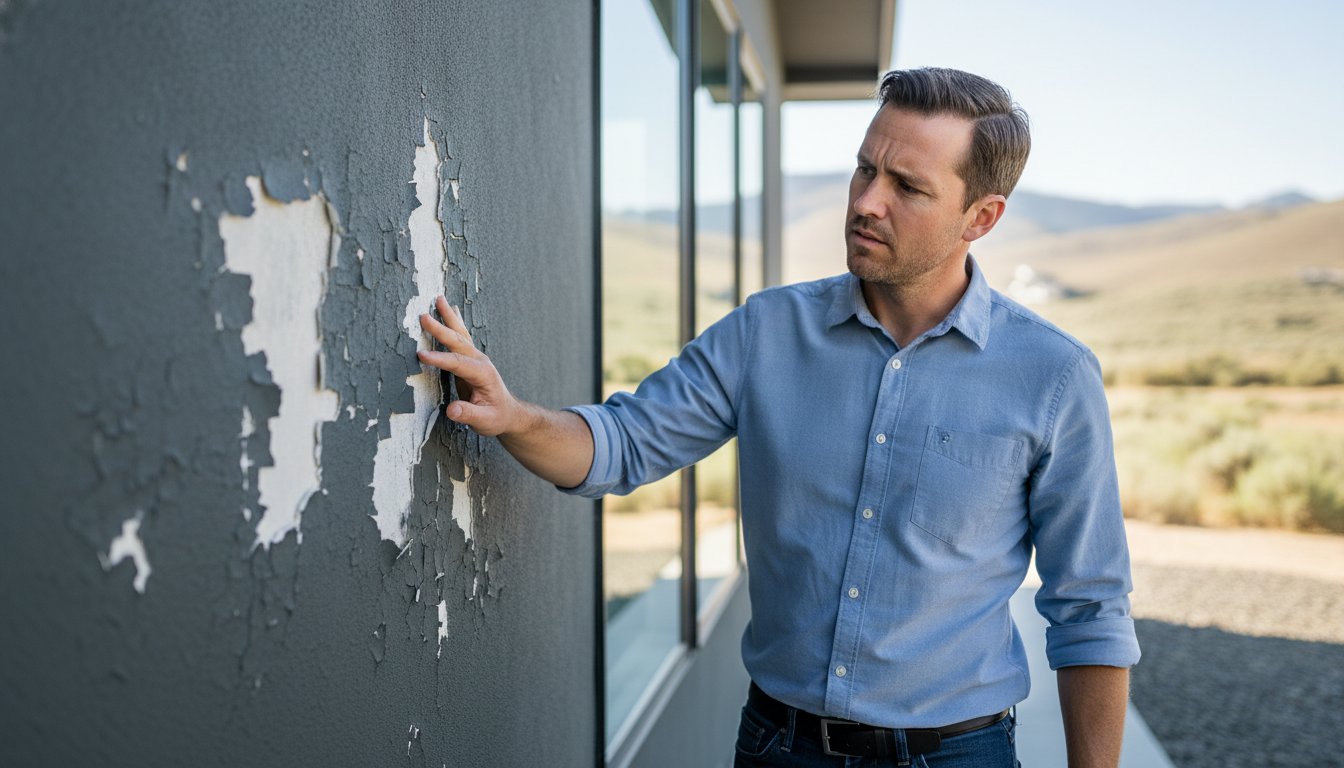
Could the "minor" streak on your new living room wall actually be a warning of a looming maintenance nightmare? Many homeowners in Kamloops feel a sense of dread when a renovation doesn't look quite right, yet they worry they're simply being too picky. It's a valid concern because a paint job is more than a color change; it's a protective layer for your most valuable asset. If you suspect your contractor took shortcuts, you're likely noticing the early signs of a bad paint job that could lead to peeling or moisture infiltration later.
We believe you shouldn't feel "taken for a ride" by subpar workmanship. You deserve a finish that reflects the accuracy and attentiveness of a skilled artisan. This article provides a clear, objective checklist of flaws to look for so you can confidently demand a fix or withhold final payment. We'll explore everything from poor surface preparation to uneven application, helping you understand exactly what a high-tier, professional finish looks like for your home.
Key Takeaways
- Identify visible interior flaws like uneven sheen and wobbly edges that signal a lack of technical expertise.
- Recognize how the unique Kamloops climate exposes poor exterior preparation through cracking, peeling, or "alligatoring."
- Master the professional walkthrough by using critical lighting and the "touch test" to detect hidden signs of a bad paint job.
- Understand why proper adhesion and surface preparation are more important than just the final color for protecting your home's value.
- Learn how a commitment to accuracy and attentiveness during the preparation phase prevents long-term damage like moisture infiltration.
Beyond Aesthetics: Why a Bad Paint Job Costs More Than You Think
You walk into the room and something feels off. Maybe the color is right, but the texture seems gritty or the edges look fuzzy. Your intuition is a powerful tool. If your gut tells you the work is subpar, you're usually looking at technical failures hidden beneath the surface. A bad paint job isn't just about a messy look; it represents a fundamental breakdown in adhesion, coverage, and surface preparation. When a contractor prioritizes speed over skill, the results are often structural rather than just aesthetic.
The Role of Paint as a Protective Barrier
Paint acts as a specialized skin for your home. In high-humidity areas like bathrooms and kitchens, it seals porous drywall against moisture that could otherwise trigger mold growth. This focus on protective finishes is a hallmark of quality renovation work, similar to the standards seen at BCR Basements, where structural integrity is prioritized alongside aesthetics. While Kamloops is known for its dry climate, our interior air can become incredibly arid during the winter months. This fluctuation puts significant stress on coatings that haven't been applied with precision. Choosing professional interior painting in Kamloops ensures that your walls aren't just colored, but fortified against environmental shifts. When a contractor skips the primer or uses low-tier materials, they leave your substrate vulnerable to premature peeling. High-quality coatings are essential for maintaining the structural integrity of your interior surfaces over many years.
Financial Impact of Subpar Workmanship
Low-cost painting often carries a heavy long-term price tag. The most significant hidden cost is remediation. If a previous worker didn't clean the walls or sand the surfaces properly, the new paint won't stick. Fixing these signs of a bad paint job often requires a professional to sand the entire surface back to the original substrate. This process is far more labor-intensive and expensive than a standard repaint. There are many technical reasons for paint failure, such as chemical contamination or improper dilution, but they all lead to the same result: wasted money.
For residential properties, visible flaws like drips or "hat banding" immediately decrease resale value. Potential buyers see a sloppy finish and wonder what else was neglected in the home's maintenance. In the industry, we define paint failure as the loss of adhesion between the coating and the substrate. Preventing this requires an artisan's commitment to thoroughness and high-tier materials. Investing in quality from the start protects your home and your budget from the cycle of constant repairs.
Interior Red Flags: Identifying Poor Workmanship on Walls and Trim
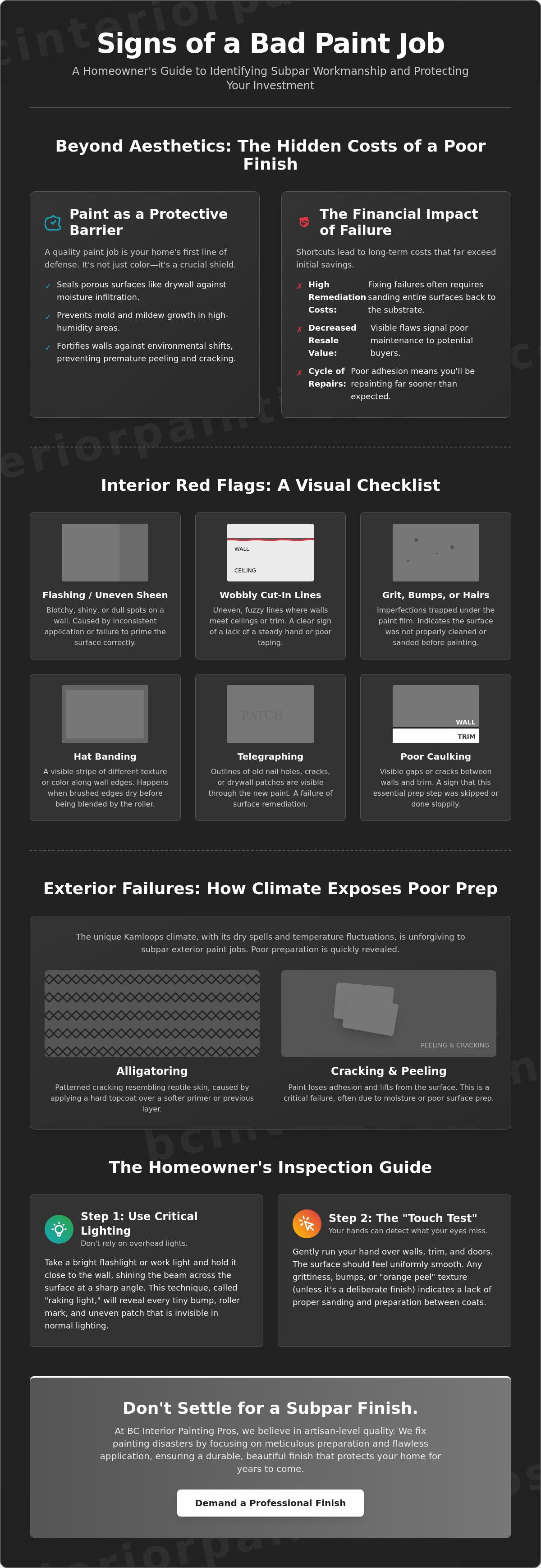
A professional interior finish should look like a single, seamless skin stretching across your living space. When accuracy is sacrificed for speed, the signs of a bad paint job become impossible to ignore. One of the most frequent indicators is "flashing." This occurs when the sheen appears uneven across a wall, often looking blotchy or shiny in some spots and dull in others. It usually stems from inconsistent application or a failure to prime the surface correctly. You might also notice "telegraphing," where the outlines of old nail holes, cracks, or previous textures are clearly visible through the new coating. A skilled artisan ensures these imperfections are completely remediated before the first drop of paint touches the wall.
Precision is especially critical at the transition points. Inspect the "cut-in" lines where your walls meet the ceiling or the baseboards. These lines should be razor-sharp and straight. Wobbly edges or paint bleeding onto the trim suggest a lack of steady handwork or the improper use of painter's tape. On large, flat surfaces, look for "hat banding," which appears as a visible stripe of different texture or color along the edges of the wall. This happens when the brushed-on edges dry before the roller can blend them into the main body of the wall, creating a permanent, distracting frame around the room.
Prep Work Failures You Can See
The beauty of a finish depends entirely on the foundation. If you see tiny bumps, grit, or hair trapped under the paint, the contractor skipped the essential step of cleaning and sanding. Dust is the enemy of adhesion. Another red flag is poor caulking. Gaps between the wall and the trim should be filled with a smooth, flexible bead of caulk; if this is missing or applied sloppily, you'll see dark cracks appearing within weeks. For those working with new drywall, the use of specialized PVA primers is mandatory. Without them, the porous drywall "sucks" the moisture out of the paint, leading to a brittle finish that fails prematurely.
Application Errors and Sloppy Technique
Gravity eventually reveals a painter's lack of attentiveness. Drips and sags on vertical surfaces are classic common interior painting mistakes that occur when too much product is applied at once. These should never be painted over; they must be sanded flat and refinished. You should also check for "holidays," which are small patches where the roller or brush missed the surface entirely, leaving the old color or primer peeking through. Finally, look at your hardware. Paint on hinges, outlets, or light switches is a hallmark of laziness. A dedicated residential painting expert protects your fixtures and ensures every corner receives the same level of thoroughness.
Exterior Failures: How Kamloops Climate Exposes Subpar Painting
The semi-arid climate of the Thompson-Nicola region serves as a brutal testing ground for any exterior finish. While an interior failure might look unsightly, an exterior failure can lead to significant structural decay. One of the most obvious signs of a bad paint job in our region is "alligatoring." This pattern of deep, interlacing cracks resembles reptile skin and occurs when a hard topcoat is applied over a soft undercoat or when the paint is exposed to intense Kamloops sun before it has fully cured. It's a clear indicator that the painter used incompatible materials or ignored the manufacturer’s temperature requirements during application.
Timing is everything during British Columbia’s seasonal transitions. Painting over damp wood during a rainy spring or a humid fall traps moisture behind the coating. As the temperature rises, that moisture turns into vapor, forcing the paint to bubble and peel away from the substrate. Professional exterior painting in Kamloops requires a deep understanding of local weather patterns and the use of moisture meters to ensure the surface is truly ready for a finish. Without this attentiveness, even the most expensive paint will fail within a single season.
For homes with stucco exteriors, keep a close eye out for "efflorescence." These white, powdery salt deposits appear when moisture migrates through the stucco and evaporates at the surface. If a painter simply applies a new coat over these deposits without addressing the underlying moisture or using a specialized masonry primer, the new finish will flake off in short order. High-tier workmanship involves identifying these moisture paths and ensuring the stucco is properly sealed and repaired before the aesthetic work begins.
UV Damage and Colour Fading
Our high-altitude sun breaks down paint binders at an accelerated rate. If your home looks dull or "dusty" within two years, you're likely seeing "chalking," which happens when poor-quality binders disintegrate into a fine powder. Certain pigments, particularly deep reds and blues, fail faster in our region if they aren't formulated with high-end UV inhibitors. An artisan approach involves selecting finishes that can withstand the extreme temperature swings from our blistering summers to our freezing winters without becoming brittle.
Stucco and Wood-Specific Red Flags
Inspect your deck railings and window sills for early peeling. This usually signals a lack of thorough cleaning or the omission of a dedicated wood primer. You should also look for cracks in stucco that were merely "painted over" rather than filled with a flexible patching compound. Exterior paint must expand and contract with the substrate to maintain a continuous protective seal. If the contractor skipped the stucco repair phase, those cracks will reappear and widen as the house settles and shifts with the seasons.
The Homeowner’s Inspection Guide: How to Conduct a Professional Walkthrough
You don't need to be a trade expert to spot technical failures. A systematic walkthrough allows you to move past the initial "new paint smell" and evaluate the actual quality of the work. By following a structured protocol, you can objectively identify the signs of a bad paint job before you issue the final payment. This process ensures that your home receives the level of accuracy it deserves.
- Step 1: Use Critical Lighting. Turn off the overhead lights and close the curtains. Use a high-lumen LED flashlight and hold it nearly parallel to the wall. This "raking light" creates shadows that expose every drip, sanding mark, and texture inconsistency that normal lighting hides.
- Step 2: Perform the Touch Test. Run your hand along the walls and trim. A professional finish feels smooth and consistent. If the surface feels gritty, tacky, or like fine sandpaper, the painter likely skipped the cleaning and sanding phases of preparation.
- Step 3: Inspect the Transitions. Look closely at the "cut-in" lines where the wall meets the ceiling, baseboards, and crown moulding. These lines should be razor-sharp. If you see paint bleeding onto the trim or wobbly edges, the technician lacked the necessary hand control.
- Step 4: Verify Coverage. Check for "grin-through," which occurs when the previous wall color or the drywall primer is visible through the topcoat. A professional job requires enough coats to achieve a solid, uniform color without blotchiness.
- Step 5: Document and Communicate. Walk the room with a roll of blue painter’s tape. When you find a flaw, place a small piece of tape next to it. This provides the contractor with a clear, undeniable "punch list" of items that require remediation.
Tools for a Professional Inspection
A high-lumen LED flashlight is your most reliable ally during an inspection. It acts as a truth-teller for any interior surface, exposing micro-textures that standard bulbs often miss. When marking flaws, always use blue painter's tape; it's designed with low-tack adhesive that won't damage the new finish you just paid for. We also recommend the "three-foot rule" used by many industry pros. If a flaw is clearly visible from three feet away under normal lighting, it is a legitimate defect that requires a fix. If you can only see it with a magnifying glass, it might fall under acceptable variance.
Handling the Conversation with Your Contractor
Communication should remain direct and professional. Distinguish between a "touch-up," which is a small spot fix, and a "full repaint," which is necessary if you notice widespread flashing or adhesion failure. If your contractor becomes defensive or insists that poor coverage is "normal," it's time for a different approach. If you’re unsure about the results you've received, contacting a professional painting company for a second opinion can provide the clarity and confidence you need to resolve the situation.
Restoring Quality: How BC Interior Painting Pros Fixes Painting Disasters
Discovering signs of a bad paint job in your home is frustrating, but these technical failures don't have to be permanent. We specialize in remediating poor workmanship by returning to the fundamentals of the craft. Our "Artisan" approach centers on the intersection of accuracy and attentiveness, ensuring that every surface receives the respect it deserves. We don't just cover up flaws; we eliminate them at the source to revitalize your living environment and provide the peace of mind you expected from the start.
Every project we undertake follows a rigorous 10-point preparation process designed to prevent the very failures discussed in this article. This systematic workflow includes thorough surface cleaning, precision sanding, and the application of high-tier primers to ensure maximum adhesion. We pay close attention to environmental factors, performing moisture checks and temperature monitoring to guarantee the coating cures perfectly. By pairing this professional execution with premium Benjamin Moore products, we create a finish that stands up to the specific environmental demands of the Kamloops region. This commitment to superior supplies ensures your home remains protected and beautiful for years to come.
Our Commitment to Professional Standards
Ready for a Flawless Finish?
We view our work as a transformative process that does more than just change a color; it revitalizes the atmosphere of your home. You shouldn't have to worry about peeling paint, messy edges, or wobbly cut-in lines. Our steady, inviting process is designed to build trust through every phase of the project, backed by our internal quality control standards and a focus on long-term results. Experience the tangible value of a job well done by a team that prioritizes your vision and the structural integrity of your property. We invite you to discover how a professional touch can turn a painting disaster into a masterpiece.
Book your free, professional painting estimate in Kamloops today!
Take Control of Your Home’s Transformation
Your home is a significant investment that deserves more than a superficial layer of color. By mastering the professional walkthrough and understanding how the Kamloops climate affects different substrates, you can protect your property from the long-term damage caused by signs of a bad paint job. Whether it's ensuring sharp interior cut-in lines or selecting UV-resistant exterior coatings, the difference lies in a commitment to accuracy and attentiveness. Taking the time to verify prep work and application techniques now saves you from the hidden costs of remediation later.
Don't settle for a finish that fails within a single season. As a locally owned and operated business in Kamloops, BC, we bring over 20 years of local industry experience to every project. We specialize in both residential and commercial transformations, focusing on the rigorous preparation that guarantees durability—a standard of excellence also championed internationally by My Paint Job Singapore. Our team views every project as a professional service rather than just a manual task, ensuring your vision is brought to life with high-tier materials. Let us revitalize your space with the skill and transparency of a true artisan.
Get a Professional Painting Quote for Your Kamloops Home
Frequently Asked Questions
How can I tell if my painter used a primer?
You can identify a lack of primer by looking for "grin-through," where the previous wall color or patches of joint compound are visible through the topcoat. On new drywall, look for a rough, uneven texture; without a proper PVA primer, the substrate absorbs the paint unevenly. If the finish peels away in large sheets with minimal effort, it's a clear indicator that the essential bonding layer was skipped.
Is it normal to see brush marks on my trim?
Minimal brush marks are expected with hand-applied finishes, but heavy ridges or "ropiness" indicate poor technique. High-tier workmanship uses self-leveling paints and high-end brushes to create a smooth, porcelain-like surface. If you can feel deep grooves with your fingernail, the painter likely applied the product too thickly or continued to work the paint after it began to set, which are common signs of a bad paint job.
What should I do if I find paint drips on my carpet or hardwood?
Address any spills or drips immediately by pointing them out to your contractor before they fully cure. Fresh drips on hardwood can often be carefully removed with a plastic scraper or a damp cloth, but paint in carpet fibers usually requires professional extraction to avoid permanent damage. These accidents suggest a lack of attentiveness during the room's preparation and a failure to use proper drop cloths.
Can a bad paint job be fixed without stripping everything off?
It depends entirely on whether the failure is aesthetic or structural. Minor issues like visible drips, "holidays," or small sections of flashing can usually be sanded flat and spot-primed before a fresh topcoat is applied. However, if the paint is peeling due to poor adhesion or contamination, the only reliable fix is to sand the surface back to the original substrate to ensure the new coating bonds correctly.
How long should a professional interior paint job actually last in Kamloops?
A professional interior finish should maintain its integrity for 7 to 10 years under normal conditions. While the dry Kamloops climate is excellent for the curing process, high-traffic areas like hallways or kitchens might require a refresh sooner due to physical wear. Longevity is directly tied to the quality of the initial preparation; shortcuts taken during cleaning or priming will significantly shorten the lifespan of the finish.
What is "flashing" and why does it happen on my walls?
Flashing appears as uneven blotches where the paint sheen looks shiny in some spots and dull in others. This technical failure occurs when a painter fails to maintain a "wet edge" during application or neglects to prime porous patches of drywall mud. It's particularly noticeable in rooms with large windows, as the natural Kamloops sunlight hits the wall at an angle and exposes the inconsistent texture.
Is the painter responsible for cleaning up dust and debris after the job?
Yes, a professional painting service includes the complete removal of all project-related waste. This includes pulling up painter's tape, removing plastic sheeting, and vacuuming any dust generated during the sanding phase. A skilled artisan treats your home with respect and ensures the environment is revitalized and ready for immediate use, leaving no trace of the construction process behind once the work is finished.
Can I withhold payment if I am unhappy with the quality of the work?
You should review your contract's terms, but many professional agreements include a "holdback" clause for the final 10 percent of the total cost. This amount is typically reserved until the "punch list" of touch-ups is completed to your satisfaction. Use blue painter's tape to mark specific flaws and discuss them clearly with the contractor; most reputable businesses prefer to fix these issues before processing the final invoice.


